Did you know that understanding amortization can save you thousands of dollars over the life of your loan? When you take out a mortgage, auto loan, or personal loan, you’re not just borrowing money; you’re agreeing to a complex repayment schedule that affects your finances for years to come.
Making informed financial decisions starts with grasping how amortization works. It’s about understanding how your monthly payment is divided between interest and principal, and how this division changes over time. By the end of this article, you’ll be able to read any amortization schedule like a pro, confidently discussing the terms with lenders and making better-informed borrowing decisions.
This guide will break down the complex concept of amortization into simple, digestible information, empowering you to analyze any loan offer more effectively and potentially saving you a significant amount of money.
What Is Loan Amortization?
When you borrow money, whether for a mortgage, car loan, or personal loan, you’re typically required to make monthly payments, which is where loan amortization comes into play. Loan amortization refers to the process of spreading the cost of a loan over its lifetime, helping borrowers manage their financial commitments.
The Two Types of Amortization
There are two primary types of amortization. The first is used for personal loans, where the borrower makes regular payments to the lender. The second type is used in business accounting to spread the cost of an expensive asset over its useful life.
Why Understanding Amortization Matters
Understanding amortization is crucial because it helps you see exactly how much of your money goes toward interest versus reducing your actual debt. Here are some key benefits:
- Making informed decisions about extra payments to reduce total interest paid over time.
- Comparing different loan offers based on the total cost over the life of the loan, not just the interest rate.
- Avoiding loans with unfavorable terms that might seem attractive initially but cost more in the long run.
| Loan Type | Typical Use | Amortization Period |
|---|---|---|
| Mortgage | Home Purchase | 15-30 years |
| Car Loan | Vehicle Purchase | 3-7 years |
| Personal Loan | Various Personal Expenses | 2-5 years |
How Loan Amortization Works
When you take out a loan, the amortization process dictates how your payments are allocated between interest and principal. While your monthly payments remain the same, the proportion of interest versus principal changes over time.
Principal vs. Interest Payments
Initially, a larger portion of your payment goes toward interest, with a smaller amount applied to the principal. As the loan progresses, this allocation shifts, with more of your payment being applied to the principal and less to interest.
The amortization effect is a phenomenon where your loan payoff accelerates over time due to the shifting balance between principal and interest.
The Changing Balance Over Time
The outstanding balance decreases slowly at first, then more rapidly as more of each payment goes toward principal reduction. This is why making extra principal payments early in your loan term can have a significant impact.
| Payment Period | Interest Payment | Principal Payment | Outstanding Balance |
|---|---|---|---|
| 1-12 months | $1,000 | $200 | $98,000 |
| 13-24 months | $900 | $300 | $95,000 |
| 25-36 months | $700 | $500 | $90,000 |
Visualizing this change over time helps you understand why making extra principal payments early in your loan term has the greatest impact. The shifting balance between principal and interest creates what’s known as the “amortization effect,” where your loan payoff accelerates over time.
Decoding Your Amortization Schedule
Decoding your amortization schedule can reveal valuable insights into your loan repayment process. By understanding how your monthly payments are applied, you can make more informed decisions about your loan.
Key Components of an Amortization Table
An amortization schedule is a table that lists each payment on your loan, breaking down how much of each payment goes toward interest and how much toward the principal balance. It also shows the total interest and principal paid to date, as well as the remaining principal balance after each payment.
| Month | Payment | Interest | Principal | Balance |
|---|---|---|---|---|
| 1 | $1,000 | $800 | $200 | $99,800 |
| 2 | $1,000 | $799 | $201 | $99,599 |
Reading the Schedule Month by Month
As you read your amortization schedule month by month, you’ll notice that the proportion of your payment going toward interest versus principal changes over time. Initially, a larger portion of your payment goes toward interest, but as the loan progresses, more of your payment is applied to the principal.
By examining the schedule, you can identify milestone months where significant shifts occur in the interest-to-principal ratio, helping you strategize when to make extra payments for maximum impact.
Calculating Loan Amortization Step by Step
Calculating loan amortization step by step allows you to grasp the intricacies of your loan payments. To start, you need to understand how your monthly payment is divided between principal and interest.
The Basic Amortization Formula
The basic amortization formula involves calculating your monthly payment based on the loan amount, interest rate, and loan term. After determining your monthly payment, you can calculate how each payment is divided between principal and interest.
Monthly Payment Calculation
For instance, if your monthly payment is $664.03, you can calculate the interest portion by multiplying your current loan balance by your monthly interest rate. In the first month, $75 of the $664.03 monthly payment goes to interest, while the remaining $589.03 goes toward the principal.
Principal and Interest Breakdown
The principal portion is simply your total payment minus the interest portion for that period. As your loan balance decreases with each payment, the interest portion naturally decreases as well.
This changing breakdown explains why more of your payment goes toward principal as time passes, accelerating your progress toward loan payoff.
| Payment Period | Monthly Payment | Interest Payment | Principal Payment | Loan Balance |
|---|---|---|---|---|
| 1 | $664.03 | $75 | $589.03 | $10,410.97 |
| 2 | $664.03 | $68.35 | $595.68 | $9,815.29 |
| 3 | $664.03 | $61.65 | $602.38 | $9,212.91 |
Creating Your Own Amortization Schedule
Creating an amortization schedule can seem daunting, but it’s a straightforward process with the right tools. You can use either spreadsheet programs or online calculators to generate your schedule.
Using Spreadsheet Programs
You can create an amortization schedule using spreadsheet software like Microsoft Excel or Google Sheets. These programs allow you to set up a table that calculates your loan payments, interest, and principal over time.
Online Calculators and Tools
Alternatively, online amortization calculators provide a quick and easy way to generate amortization schedules. These tools typically require just three inputs: loan amount, interest rate, and loan term.
Key benefits of online calculators include:
- Online amortization calculators provide a quick and easy way to generate amortization schedules without building them from scratch.
- These tools typically require just three inputs: loan amount, interest rate, and loan term.
- Many online calculators offer additional features like the ability to account for extra payments or compare different loan scenarios.
- Some specialized calculators focus on specific loan types, such as mortgages, auto loans, or student loans.
- Using these tools can save you time while still providing the insights you need to make informed borrowing decisions.
Loan Amortization Examples in Real Life
Let’s dive into real-life examples to see how loan amortization works in different scenarios. Understanding how different types of loans amortize can help you make informed financial decisions.
Mortgage Loan Example
A mortgage loan is a significant financial commitment. For instance, a $200,000 mortgage at 4% interest over 30 years will have a monthly payment of approximately $955. Although mortgage details aren’t provided, it’s essential to understand that a substantial portion of early payments goes toward interest.
Auto Loan Example
For a $30,000 car loan at 3% interest with a term of 4 years, the monthly payment is $664.03. In the first month, $75 goes to interest and $589.03 to principal. In the final month, only $1.66 is paid in interest because the outstanding loan balance is minimal.
Personal Loan Example
Personal loans typically have terms of 2-7 years and often carry higher interest rates than secured loans like mortgages. For a $10,000 personal loan with a 3-year term and 10% interest rate, the monthly payment would be approximately $323. In the first month, about $83 would go toward interest and $240 toward principal.
| Loan Type | Loan Amount | Interest Rate | Term | Monthly Payment |
|---|---|---|---|---|
| Auto Loan | $30,000 | 3% | 4 years | $664.03 |
| Personal Loan | $10,000 | 10% | 3 years | $323 |
These examples illustrate how loan amortization works across different loan types and terms, helping you understand how your payments are allocated over time.
Types of Loans That Amortize (vs. Those That Don’t)
Not all loans are created equal, and knowing which ones amortize can help you make informed financial decisions. Amortizing loans are repaid in fixed installments over a set period, with each payment covering both interest and principal.
Common Amortizing Loans
Most mortgages, auto loans, and personal loans are amortizing. For example, a mortgage loan is a typical amortizing loan where you make monthly payments that gradually reduce the principal amount over time.
| Loan Type | Typical Term | Payment Structure |
|---|---|---|
| Mortgage | 15-30 years | Fixed monthly payments |
| Auto Loan | 3-6 years | Fixed monthly payments |
| Personal Loan | 2-7 years | Fixed monthly payments |
Non-Amortizing Loans: Interest-Only and Balloon Loans
Some loans, like interest-only loans, require payments that only cover the interest for a specified period. Balloon loans, on the other hand, have a large payment at the end of the loan term.
Credit Cards and Revolving Debt
Credit cards represent a common form of non-amortizing debt. The outstanding balance can be carried month-to-month, and the payment amount can vary. Interest is calculated based on the average daily balance during the billing period.
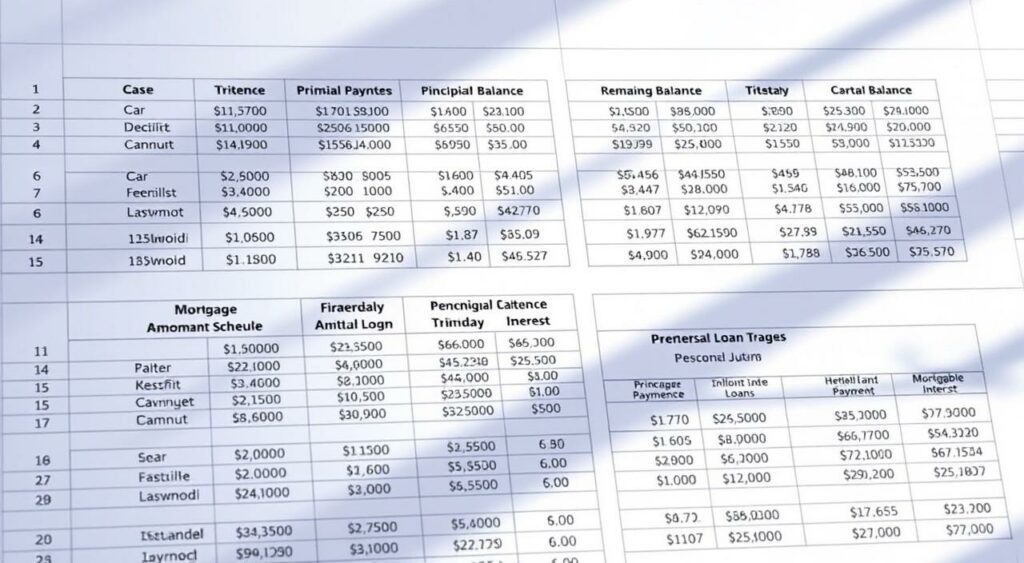
Mastering Amortization for Better Financial Decisions
Understanding loan amortization empowers you to take control of your financial future. By grasping how loan amortization works, you can make informed decisions about borrowing and manage your debt more effectively.
An amortization calculator can help you explore different loan scenarios, showing how changes in interest rate, term, and loan amount affect your monthly payments and total interest paid.
With this knowledge, you can compare loan offers beyond just the interest rate or monthly payment, develop strategies for paying off debt more efficiently, and potentially save thousands in interest over the life of the loan.
By mastering amortization, you’ll become an informed consumer who can optimize loan terms to support your broader financial goals.